By Lily Hayward-Smith
Introduction
There are multiple forms of online dance and the Moving Online project commissioned three artists to make a dance film that would be shared primarily online. Hetty Blades, Vipavinee Artpradid and I observed the commissioned artists in the making and filming processes with some specific questions in mind that probed the existence of these dance entities, their authorship and considerations around ownership. This blog post focuses specifically on my observations of Anjana Bala and her collaborators in the making process for Optics her final film which was premiered and features on Sadlers Wells digital stage and can be viewed here.
Hetty and I joined Anjana in a studio at East London Dance, in Stratford, London in April 2024. Anjana is a dance artist and anthropologist with a background in Bharatanatyam. She was also joined by two other female Indian dancers Aishani Ghosh and Ahdya Shastry whom Anjana had previously worked/danced with several times.
I entered the process on the second day of rehearsals when Anajana was joined by the two other dancers. This was the first time the dancers would be learning the choreography from Anjana who had spent the previous day developing this with the rehearsal director Nandita Shankardass. I then re-joined Anjana on day four in the Klatch Studio Black Box in West London for the filming day. The crew filming the dancers were Cathy Ye and Wilkie Branson. Also in the room was the rehearsal director and Moving Online project intern Issac Lee who was involved in documenting the observation process.
The reason for these observations is that we are interested in how online dances are made, the considerations the choreographers and dancers go through and if and how this differs from the making process for other types of dance, for example for live performance.
The methodology Hetty devised for these observations was to have a number of questions to act as a guide, and to make notes that might find their way to answer some of these questions. Subsequently we would share our notes in a grid that was divided up by these questions. It was not a strict rule to stick to these questions however, Hetty also asked me to note down anything that was of interest even if it was not related to the questions, but having them at the beginning gave us a lens with which to witness these artists in their making processes to get us started.
The questions:
- How are choreographic decisions made?
- How does the structure/form/score for the dance take shape?
- What references are there to the ‘work’/’piece’/’dance’ etc?
- Are there moments in which the dance seems to solidify/emerge (either through choreographic decisions or dialogue)?
- What references are made to the conventions of the specific dance form(s)?
- What references are made about the ownership of the dance?
- What references are made to the authorship of the dance (as different to ownership)?
The questions that seemed to be the most relevant to the first day of my observations were 1,2,4 and 5. Anjana was still in the process of forming the piece and setting the movements that she had developed the previous day. What we witnessed was the group testing the movements together and separately in order to see what worked, how it fitted with the music, how it looked and if it suited the story Anjana wanted to tell. This process felt very familiar, my embodied memories of making dance choreography and learning another artists choreography surfaced and this did not feel any different to how a dance is made for any other non-online format at this part of the process.
Observations on choreographic decisions
The following observations I would like to share were in most part about how the choreographic decisions were made and noticing when the piece seemed to solidify.
On day 2 Anjana was stepping into the process of sharing her choreography with the dancers for the first time. The three of them were familiar with each other which made for a very relaxed atmosphere. Anjana used the familiar tool of counting the timing, “1,2,3,4,5,6,7,8”, whilst performing the moves for the dancers to show them what to do. Anjana’s approach felt very open and generous. It was clear that she had questions about the choreography and how it synced with the music, the timing, especially of movements where the dancers were in cannon and the story that they were telling with the movements and their intentions in how they performed the dance. I think that she was also interested in how the movements would sit in the bodies of the dancers. Being three individuals with different dance personalities there is nuance to the way they repeat the choreography that Anjana has taught them. These are three dancers with a grounding in Bharatanatyam and whilst the choreography was not traditional to this style there were influences visible and some specific movements that Anjana described as Bharatanatyam movements for example the ‘dola’. The shared language that they had to describe these movements was a useful tool for Anjana in imparting the choreography to the dancers.
The dancers also had their own questions, for example about the stylistic elements and timing. The process evolved into each of them at times stepping out to witness each other and then make decisions to solidify the choreography. In this way they all have an influence on the dance, and this made me ask the question, does this make them all authors and are they aware of this during the process? Or as ultimately Anjana has the responsibility for the piece does this give her the overriding ownership and say in the ontological existence of this dance entity?
Anjana was so generous with her thought processes – speaking out loud her ideas, her queries, her doubts and seeking the opinion and approval of the dancers. This was how the choreographic decisions were made, collectively, however Anjana would ultimately be taking on the responsibility of a decision, so then I asked myself does this make her the owner of the dance? Does responsibility, having the original idea and bringing the whole thing together count when it comes to ownership? Again, are Anjana and the dancers considering this? It was not something I witnessed being discussed out loud. Are they just getting on with it as dancers do, enjoying the process and the moments of dancing, is that all that matters (to them). Questions 6 and 7 referencing ownership and authorship did not feature in my notes of this day. My guess is that thoughts about this would only emerge from the dancers when asked about considering these ideas.
Early on in the observations I noticed how the dancers used the mirror in the studio as a tool in the making process and how this helped the dance take shape. The mirror became their audience this is a perfectly normal and typical process or tool for choreographing a dance work, many dancers will be familiar with the mirror in a dance rehearsal and making space but within the context of observing how choreographic decisions are made the use of the mirror as an external eye in this was really interesting to me. Ultimately the audience for this work will be through the “eyes” of the camera and as I discovered later on the audience will not see the dance in the same way that Anjana and the dancers were witnessing in the studio through the mirror. The piece is now filmed and shared online, the sense of the dancers’ experience and feeling are further removed from the audience when watching dance online than if you are watching the dance live and can see and hear breath and the sounds of the dancers on the floor and feel the vibrations of the space.
At some point in the day Anjana began to refer to ‘the light’, an imaginary one which would become real when the filming begins, and that this was the focus for the dancers. This gave more of a spatial structure to their working on the choreography. For the dancers understanding what their parameters were and imagining an invisible object gave the dancers character.
The group continued to work on the dance on day 3 and on day 4 I joined them in the filming process.
Deepening our observation of ownership
Observations on this day lent more towards thoughts for me around ownership and authorship. This was I believe because there were now possibly other and new “authors” involved. The dance work also starts to transform as it is taken from the physical movements of the choreography that currently only exist ephemerally each time they are “performed” by Anjana et al. to being captured in these moments by the camera. Now there there was another layer to the piece, which was led by Cathy and Wilkie. This made me ask questions about the transference or adding of authorship and ownership. There are layers of this here, the dance choreography is one layer, the origins are Anjana’s, the performance of the choreography, the plans for the filming and the filming itself for example. Are each of these elements owned separately?
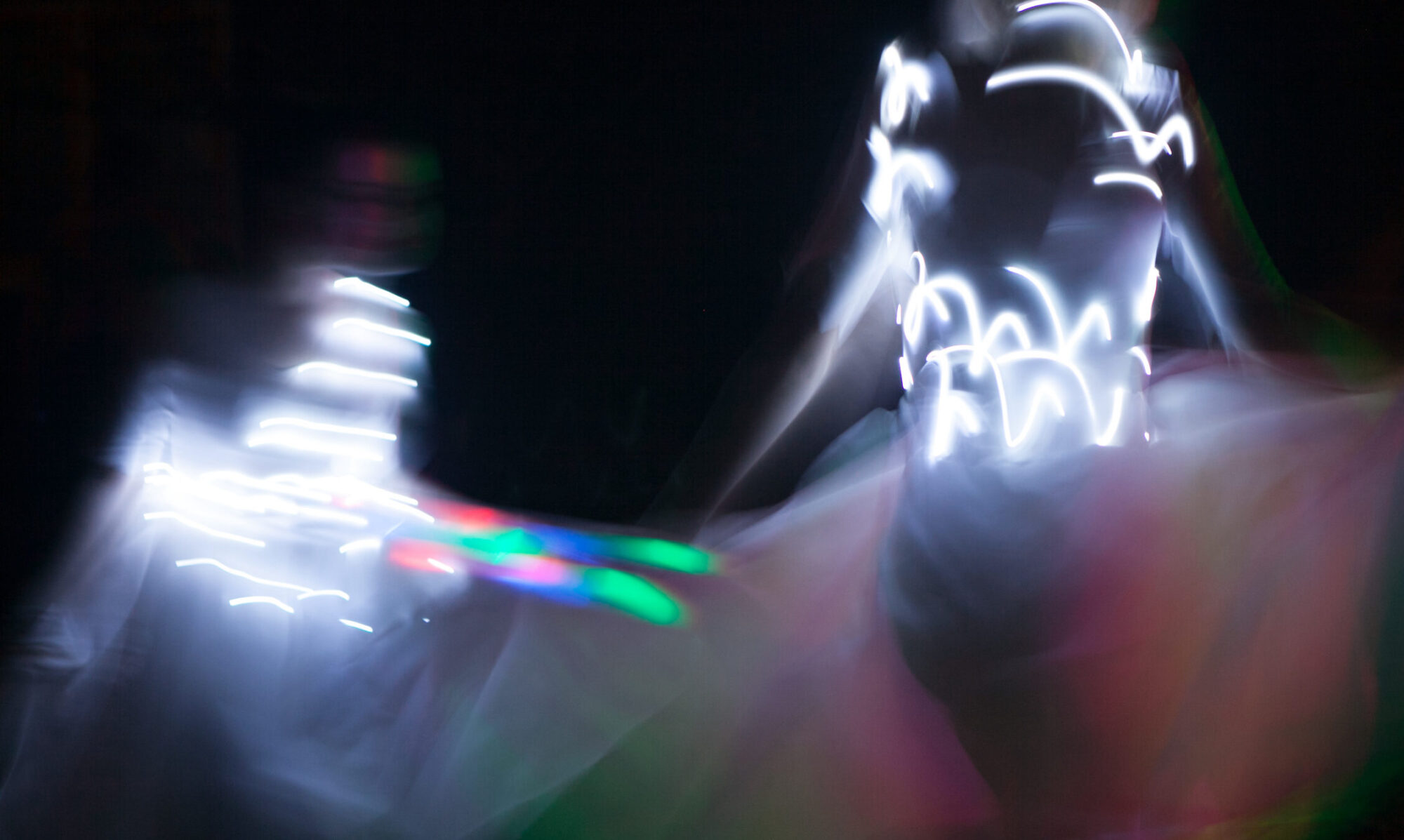
Some of the differences I observed in the filming process to the studio days earlier in the process were; How other people were now making decisions based on their roles in the process, how the dancers were now able to see it through the audiences’ eyes now by viewing footage as they went along and not relying on what they saw in the mirror or in watching each other, how now the choreography was developing through the filming process as the spacing was being dictated by the black box space, the camera angles and the use of light. I also wondered if the dancers were “performing” the dance differently in front the camera than they would to a live audience, because there was more than one chance to get it right. I was interested in the role of Cathy the videographer, she was choosing different angles and the camera’s proximity to the action, the audience will ultimately witness these decisions. There is a particular focus on Anjana’s hands in one section of the film as it crescendos towards the end, the camera closely captures her hands moving in a frantic sequence of gestures, this element of the dance would be viewed very differently were it to be performed in a live setting. This led me to question does the dance exist in more than one entity? In the live ephemeral version and in the version that is captured and viewed through the medium of film.
Some of these observations and questions remain open for debate but they reveal something about how ontologically dance exists in different ways, authorship can be multilayered and the things raised here have informed the Moving Online Guidelines resource (which will be available online soon) and will continue to inform future writings.
References
Anjana, B. 2024. Optics. Sadlers Wells Digital Stage. [Seen 27 January 2025 at https://www.sadlerswells.com/digital-stage/meet-the-rose-choreographic-school-cohort/]
